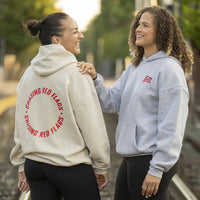








Two different projects. Two very different life stories. But one belief connects so much of what we’re both trying to do: what we go through doesn't have to end with us.
Sometimes it starts with an honest answer to a question. Sometimes it’s telling your story. Sometimes it’s having a conversation you've been avoiding, asking for help, creating something, or applying what you've learned to help someone else.
You don't need to have everything figured out. You don't need a perfect story or a perfect ending. You just need a place to begin.
For Let’s Get Real, that beginning is getting honest with yourself and turning that honesty into a deeper connection with others. For HINESIGHTS Academy, it’s taking what you've lived and learned and discovering what you can do with it.
Different paths, same reminder: your story matters, and what you choose to do with it can matter, too.
So instead of a traditional blog, we decided to do something a little different: ask each other the questions behind what we've created, why we created it, and what we hope it can do for others.
ELLA ASKS KEVIN: INSIDE HINESIGHTS ACADEMY
Kevin Hines has spent more than 25 years turning lived experience into advocacy, education, and impact. His newest venture, HINESIGHTS Academy, brings those lessons together in a personalized platform designed to help others turn what they've lived and learned into purpose of their own.
Ella asked Kevin 10 questions to find out what HINESIGHTS Academy really is, why he created it, and who he hopes it will help.
1. Kevin, for someone hearing about HINESIGHTS Academy for the very first time, what is it, and what made you realize, “I need to create this”?
- HINESIGHTS Academy is the culmination of more than 25 years of my life’s work. It is everything I have learned about storytelling, speaking, writing, filmmaking, advocacy, building a mission, creating a business around purpose, and most importantly, learning how to take what you have lived through and use it to build something meaningful. I realized I needed to create it because people have asked me the same question all over the world: “Kevin, how did you take what happened to you and turn it into what you do today?” The truth is, there was no roadmap for me. I learned by doing, failing, getting back up, making mistakes, finding mentors, listening, studying, creating, and continuing when things did not work. HINESIGHTS Academy is the roadmap I wish someone had handed me when I was beginning.
2. You’ve spent more than 25 years sharing your story, speaking around the world, writing books, making films, and advocating for mental health. How did you take everything you’ve learned and turn it into something other people can now use for their own lives?
- I had to look beyond the accomplishments and really examine the lessons underneath them. Speaking around the world taught me how to communicate with people, but it also taught me how to listen. Writing books taught me how to turn memories and ideas into stories. Filmmaking taught me how to translate a mission into something people can see, hear, feel, and hopefully never forget. Advocacy taught me that creating change requires far more than having a powerful story. You have to learn how to turn that story into action. So I took those lessons and built them into practical tools people can actually use. HINESIGHTS Academy is not about somebody trying to become Kevin Hines. I do not want another Kevin Hines. I want people to discover the fullest version of themselves. I want to help you uncover what only you can bring to this world and then give you the tools to actually do something with it.
3. You’ve said HINESIGHTS Academy isn’t just another online course. What makes it different from the mental health, self-development, or coaching programs that are already out there?
- I do not believe people need another program that talks at them. I wanted to build something that works with them. HINESIGHTS Academy combines lived experience, practical education, storytelling, mental wellness, personal development, creativity, purpose, and real world implementation. I am sharing lessons I have actually lived. These are not theories I developed sitting behind a desk. They come from more than two decades of getting on stage, writing books, making films, building campaigns, working with organizations, creating businesses, making mistakes, rebuilding, and learning how to stay mentally well enough to keep doing the work. But the greatest difference is that the Academy is not asking, “How can you follow Kevin’s path?” It asks, “What is your path, and how can we help you build it?”
4. One of the biggest ideas behind the Academy is helping people turn their lived experience into purpose and impact. What would you say to someone who thinks, “My story isn’t important enough to share”?
- Your story does not have to be extraordinary to matter. It just has to be yours. One of the biggest mistakes we make is comparing our experiences to everybody else’s and deciding someone else has suffered more, accomplished more, overcome more, or has something more valuable to say. But somewhere in this world there may be one person who needs to hear something in exactly the way that only you can say it. You also do not have to share every part of your life publicly. Purpose does not require exposure. Your lived experience can inform how you parent, teach, lead, create, advocate, build, serve, or simply show up for another human being. Your story has value because your life has value. The question is not whether your story is important enough. The question is what have you learned from living it, and what might those lessons allow you to give?
5. The Academy uses AI to personalize the experience for each person. What does that actually look like when someone signs up? If I joined today, how would my experience be different from someone else’s?
- Technology allows us to move away from the idea that everybody should receive exactly the same journey. When you enter HINESIGHTS Academy, the goal is to understand what you are trying to accomplish, where you are right now, what you are interested in, where you may feel stuck, what skills you want to strengthen, and what kind of future you want to build. Your pathway can then become more relevant to you. If you joined because you wanted to write your story, your experience should help you move toward becoming a stronger writer and storyteller. Someone else may want to become a public speaker. Another person may want to make a documentary, develop an advocacy campaign, build a purpose driven business, or simply understand themselves better and strengthen the way they approach their own life. AI should never replace human connection, human judgment, or human compassion. I see it as a tool that can help make education more responsive and useful. The technology personalizes the pathway. The human being remains at the center of it.
6. Who did you create HINESIGHTS Academy for? Do you have to want to become a speaker, author, advocate, or entrepreneur, or is there something here for someone who simply wants to work on themselves and their own mental wellness?
- You absolutely do not have to want to become a speaker, author, filmmaker, advocate, creator, or entrepreneur. Those pathways are there because they are areas I have spent decades learning, and I want to give people practical tools if that is where they want to go. But HINESIGHTS Academy begins much deeper than a career. It is for the person asking, “What do I want my life to stand for?” It is for someone who has lived through something and wants to understand what comes next. It is for someone who has an idea they cannot stop thinking about. It is also for someone trying to find their voice, rebuild their confidence, strengthen their mental wellness, create something meaningful, or discover a greater sense of direction. You do not have to build a platform. Sometimes the greatest impact you will ever have happens in a room with one other person.
7. You talk a lot about turning pain into purpose. How do you help someone do that without feeling like they have to make their hardest experiences their entire identity?
- This is incredibly important to me because I never want anyone to believe they owe the world their trauma. What happened to you is part of your story. It does not have to become the definition of your existence. I survived an incredibly difficult chapter of my life, but I am not simply the worst thing that ever happened to me. I am a husband. I am a son, brother, friend, creator, storyteller, filmmaker, author, speaker, advocate, and human being who is still learning and growing. Turning pain into purpose does not mean living inside that pain forever. Sometimes purpose means helping someone else. Sometimes it means creating something. Sometimes it means changing how you live. Sometimes it simply means deciding that what happened to you will not determine everything that happens next. The goal is not to build an identity around your wounds. The goal is to discover what can grow beyond them.
8. What is one lesson, exercise, or part of the Academy that you’re especially proud of, something you wish you had access to when you were younger?
- I wish someone had taught me earlier that purpose does not arrive fully formed. You build it. When I was younger, I thought people who were successful or impactful somehow knew exactly what they were doing. I certainly did not. I had to learn that you can begin before you feel ready, that failure can teach you something without defining you, and that your first attempt does not have to be your final form. One of the ideas inside HINESIGHTS Academy that means the most to me is helping people take what feels enormous and break it into the next possible action. You do not have to know what your life will look like ten years from now. Sometimes you need to know what you can do today. I wish someone had sat me down when I was nineteen and told me, “Kevin, you cannot see the life ahead of you yet, but that does not mean there is not an incredible life ahead of you.”
9. You’ve built an incredible career from being willing to be vulnerable and tell the truth about your life. What do you hope someone learns through the Academy about the difference between simply sharing their story and sharing it in a way that can actually create change?
- Vulnerability alone is not impact. You can tell somebody everything that has ever happened to you, but if the audience leaves carrying only your pain, you may have told a powerful story without giving them somewhere to go with it. Impactful storytelling asks another question: “What can someone do with what I have shared?” When I tell my story, I never want the takeaway to simply be that Kevin Hines survived. I want someone listening to recognize something about themselves. I want them to understand that their thoughts do not have to become their actions. I want them to know they can ask for help. I want them to understand the power of saying four simple words when they are struggling: “I need help now.” A story becomes transformative when it creates movement in somebody else. It can move someone toward compassion, toward action, toward treatment, toward advocacy, toward forgiveness, toward purpose, toward another human being, or toward tomorrow. That is what I want Academy members to learn. Do not simply ask, “How do I tell my story?” Ask, “How can my story serve?”
10. If someone is listening right now and feels like they have something inside of them, a story, an idea, a purpose, but they have absolutely no idea what to do with it, what would you want them to know about HINESIGHTS Academy and where it could help them begin?
- I would tell them that not knowing where to begin is a beginning. You do not need a perfect plan. You do not need a massive following. You do not need a book deal, a film crew, a stage, a company, a million dollars, or somebody else’s permission. You need a willingness to discover what matters to you and the courage to take the first meaningful step toward it. That is exactly where I want HINESIGHTS Academy to meet people. Come in with the story you do not know how to tell. Come in with the idea scribbled in your notebook. Come in with the dream you have been afraid to say out loud. Come in knowing what you want to do, or come in having absolutely no idea what comes next. We can start there. Because your lived experience is not a limitation. What you have learned matters. What you have survived, discovered, built, lost, loved, questioned, and overcome can teach you something about where you are going. HINESIGHTS Academy is about helping you uncover those lessons, develop the tools to use them, and begin turning insight into action, action into purpose, and purpose into impact. You do not have to have the whole road figured out. You just have to be willing to take the first step.
Then we flipped the interview. Kevin asked Ella 10 questions about Let’s Get Real, from the personal experiences that inspired the journal and why she created it with her mom, to the idea of taking journaling from ME to WE, giving back to mental health organizations, and what they hope happens when people are willing to answer the questions they might normally avoid.
KEVIN ASKS ELLA: INSIDE LET’S GET REAL
1. Ella, for someone hearing about Let’s Get Real for the first time, what is it, and why did you and your mom feel like this journal needed to exist?
- Let’s Get Real is a guided journal that helps you get really honest with yourself...about who you are, your relationships, your patterns, your fears, your confidence, all of it. My mom and I started Chasing Red Flags because we'd both been through really hard times in our lives, just at completely different ages. And we realized that even though our experiences were different, so many of the things underneath them were the same. We also felt like there were a lot of journals telling you to be grateful, think positively, or become the best version of yourself. And those things are great, but sometimes you need someone to ask you the questions you don't necessarily want to ask yourself. That’s what we wanted this journal to do. Not fix you or change you...just help you understand yourself better and get real about what's actually going on.
2. You’ve been really open about your own struggles and the experiences that shaped you. How much of your own life ended up influencing the questions and prompts in this journal?
- So much of it. There are definitely prompts where, when I read them, I know exactly what experience in my life they came from. I've been through anxiety, struggles with my mental health, an eating disorder, a really unhealthy relationship, heartbreak, losing confidence in myself, and just times when I really didn't know who I was anymore. A lot of the questions came from things I wish someone had asked me when I was going through those experiences. And my mom brought completely different life experiences to it. So even though it's not a journal about our stories, our stories are definitely woven throughout it, and they are stories a lot of people can relate to.
3. There are so many journals out there. What did you feel was missing from them, and what makes Let’s Get Real different?
- We wanted people to actually stop and think. There are 13 chapters and more than 240 prompts, and they go into things like patterns, fears, relationships, boundaries, confidence, forgiveness, resilience, gratitude…Some of the questions are uncomfortable. But those are sometimes the questions that teach you the most about yourself. It’s not all heavy. There are quotes, activities, affirmations, coloring pages, and different ways to use it. The biggest difference, though, is that it doesn't end with you. We wanted to take journaling from ME to WE, because we think the real magic happens when some of these private reflections become honest conversations with others.
4. The journal asks people to be really honest with themselves, about relationships, patterns, fears, boundaries, confidence, and even forgiveness. Was there a section that was especially difficult for you to write or work through yourself?
- Relationships and patterns were probably the most personal for me. I was in an unhealthy on-and-off relationship for years, and when you're in something like that, it's really easy to focus on what the other person did wrong. It's a lot harder to ask yourself, "Why did I keep accepting this? What was I afraid of? What pattern was I repeating? What did I believe I deserved at that point in my life?” Those questions can be uncomfortable because suddenly you're not analyzing somebody else...you’re looking at yourself. BUT that's also where I learned the most. Not blaming myself for what happened, but understanding myself enough to make different choices going forward.
5. One thing I love about what you created is that it isn't just about writing, it’s about connection. Can you explain the “ME to WE” idea behind the journal and why you wanted people to eventually take these conversations beyond the page?
- This is probably one of my favorite things about the journal. Journaling is usually such a private thing. It's ME; my thoughts, my feelings, my journal. And that's incredibly valuable, but my mom and I kept thinking, what if it didn't have to stop there? What if something you discover about yourself becomes a conversation with your mom, your best friend, your coworker, your partner, your roommate, or even your therapist? That's ME to WE. You start by being honest with yourself, but then maybe you feel safe enough to share something. And suddenly someone else says, "Wait, I feel that way too.” That's where connection happens. And I think so many of us are walking around thinking we're the only ones feeling something when we're really not.
6. You and your mom created this together from two very different generations. How did that shape the journal, and were there things you learned about each other while writing it that you hadn't known before?
- It was honestly one of the coolest parts of creating it because we're at completely different points in our lives. There were questions I thought were really important at 22 that my mom might never have thought to include, and there were questions she brought up from her life experience that I wouldn't have known to ask yet. And we definitely learned things about each other. There were moments when one of us would answer a prompt, and the other would be like, "Wait, I never knew that.” It showed us that you can know someone your entire life and still not know everything they're carrying. And that's a huge part of what we want Let's Get Real to do...give people a reason to have conversations they might never think to have otherwise.
7. Chapter 13 is really unique because it’s designed to be done with someone else. Why was it important to you to include that, and what have you seen happen when people actually sit down and have those conversations together?
- Chapter 13 is really the WE part of ME to WE. You choose someone….a friend, parent, partner, sibling, coworker, whoever...and you go through questions together. And I love it because you don't have to have some huge emotional conversation out of nowhere. The journal gives you permission to ask things you might otherwise feel awkward asking. We've heard about couples using it, friends using it, families, therapists, coworkers; and that's exactly what we hoped would happen. Sometimes one good question can completely change a conversation and a relationship.
8. Giving back is a big part of Let’s Get Real. You donate $1 from every journal sold to mental health organizations. Why was it important to you and your mom to build that into the journal from the beginning, and how do you choose the organizations you support?
- Giving back was something my mom and I knew we wanted to be part of this from the very beginning. We never wanted Let’s Get Real to just be something we sold. We wanted every journal to have an impact beyond the person who bought it. So we donate $1 from every journal sold to different mental health organizations. We try to choose organizations doing meaningful work in areas that connect with our mission and, in many cases, issues that have touched our own lives or the lives of people in our community. For us, it's this idea that buying one journal can do two things at once. Hopefully it helps the person holding it understand themselves, have better conversations, and feel less alone, and at the same time, that purchase is helping support organizations doing really important mental health work for other people.
9. Since the journal has been out in the world, have you heard a story or reaction from someone using it that made you stop and think, “This is exactly why we created this”?
- There have been so many, but honestly some of my favorites are when people tell us, "I'm not a journal person, but I actually use this.” And when someone tells us a question made them realize something about themselves they'd never realized before, or helped them have a conversation they had been avoiding. Selling a journal is amazing, obviously. But knowing that something we wrote actually created a moment of honesty or connection in someone's real life? That's why we made it.
10. If someone is listening right now who says, “I’m not a journal person,” or maybe they’re even a little afraid of what might come up if they start answering these questions, what would you say to them?
- I would say, perfect. You don't have to be. You don't have to wake up every morning and journal for 30 minutes. You don't have to fill every line. You don't have to be a good writer. There really aren't rules. Open to a question that speaks to you. You don’t have to go in order…it’s undated for that reason. Write two sentences. Color a page. Do an activity. Bring a question to dinner and ask your best friend. Or answer something and never show another person. And if you're a little afraid of what might come up, I understand that too. Some of these questions have made me uncomfortable. But I think sometimes the question you're avoiding is the one worth sitting with. You don't have to figure everything out. You just have to be willing to get a little more honest with yourself.
Maybe that's where both of these journeys really begin: one honest question, one honest answer, and the willingness to see where it takes you.
Keep asking the hard questions. Keep having the real conversations.
Ella & Kevin
https://www.instagram.com/kevinhinesstory/